Over the years, I’ve coached executives, sales leaders, business owners, and professionals through promotions, restructures, career transitions, business growth, and uncertainty.
One thing has become increasingly clear:
The leaders who navigate uncertainty best aren’t the ones with all the answers. They’re the ones who know who they are.
That idea reminded me of one of my favourite books, The Happiness Advantage by Shawn Achor.
The research behind Positive Psychology challenges a belief many of us have been taught:
“I’ll be happy when…”
I’ll be happy when I get the promotion.
When I hit my sales target.
When business slows down.
When the project is complete.
When life feels less chaotic.
The science tells us something different.
Our mindset doesn’t simply reflect our success—it helps create it.
When we cultivate optimism, resilience, purpose, and strong relationships, we think more creatively, solve problems more effectively, and make better decisions under pressure. Well-being isn’t the reward for success; it’s one of the drivers of it.
That doesn’t mean ignoring difficult realities or pretending everything is positive. It means developing the internal resources to respond thoughtfully instead of reacting emotionally.
As leaders, that’s where our greatest influence lies.
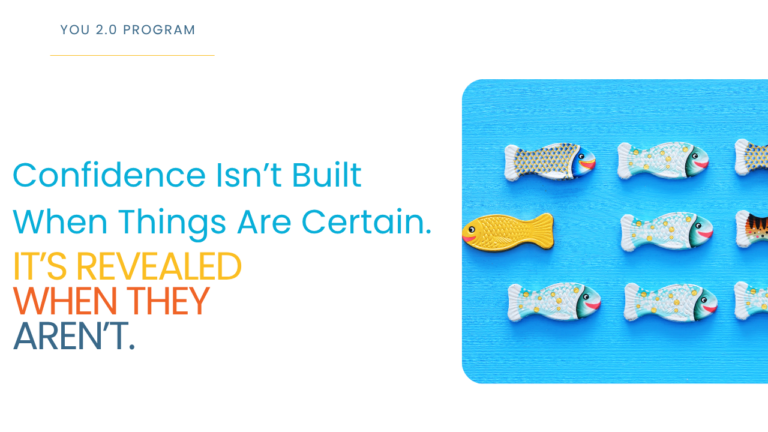
When uncertainty increases, many leaders begin searching outside themselves for confidence. They seek reassurance from changing market conditions, positive feedback, or certainty about the future.
But authentic confidence comes from something much more stable.
It comes from understanding your values. Knowing your strengths. Recognizing your patterns under pressure. Leading in a way that aligns with who you are rather than who you think others expect you to be.
I’ve seen exceptionally talented people lose confidence because they tied their identity to a title, a performance rating, or someone else’s opinion.
I’ve also seen leaders thrive through significant change because they remained anchored in their purpose and strengths, even when the circumstances around them shifted.
That is the difference between confidence that is dependent on circumstances and confidence that is grounded in self-awareness.
It’s also why I believe the future of leadership isn’t about working longer hours or constantly doing more.
High performance doesn’t require running yourself into the ground.
It requires creating the conditions where people can perform at their best—physically, mentally, and emotionally.
The strongest sales leaders don’t just coach performance; they coach belief.
The strongest people leaders don’t simply manage tasks; they develop capability.
The strongest organizations don’t rely on burnout; they create cultures where well-being and accountability coexist.
That’s the kind of leadership our workplaces need more of.
Leadership isn’t about having all the answers.
It’s about helping people discover they are more capable than they believed.
And that begins with knowing yourself first.
Coaching Question:
When uncertainty shows up, what do you anchor yourself to—your circumstances, or your strengths?
Leadership is about more than achieving results—it’s about creating the conditions where people and performance flourish together.
☕ Ready to elevate your leadership? Book a Java with Jenn coaching session or explore practical leadership resources at Jimbere Coaching & Consulting. If you know you are ready to partner with a proven coach and grow your joyful confidence consider going straight into my YOU 2.0 Program for a longer term partnership. Getting you to your next level – that’s my specialty – what you think is possible is just the beginning!
Question for you: What insight from today’s article will you put into practice this week?