There is a question I often ask high-performing leaders:
When was the last time you made an important decision before you were already exhausted?
The answer is usually silence.
Not because they don’t make important decisions.
Because they make so many.
Every day leaders decide:
- priorities
- budgets
- staffing issues
- competing requests
- organizational changes
- team challenges
- customer concerns
- strategic direction
- risk management
- performance issues
And while these decisions may seem small in isolation, together they create something many successful leaders never recognize:
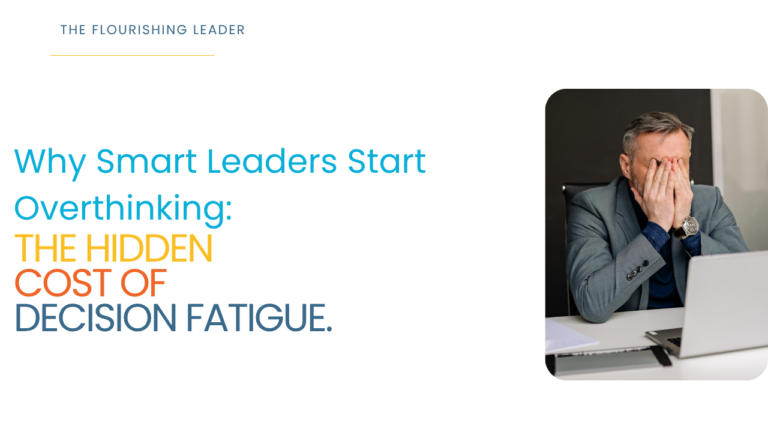
Decision fatigue.
The irony is that some of the smartest, most capable leaders I work with begin questioning themselves precisely because they have become exceptionally good at carrying responsibility.
They begin to wonder:
- Why am I overthinking this?
- Why does every decision feel heavier?
- Why am I second-guessing myself?
- Why am I losing confidence?
- Why does leadership suddenly feel harder?
The answer is often not a lack of capability.
It’s cognitive overload.
The Hidden Cost of Being the One Everyone Relies On
High-performing leaders frequently become victims of their own success.
Because they:
- solve problems
- make good decisions
- remain calm under pressure
- deliver results
More decisions naturally find their way to them.
At first, this feels rewarding.
You become the trusted advisor. The dependable leader. The person who can handle complexity.
Eventually, however, being capable becomes being responsible for everything.
And that responsibility carries a cost.
Every decision requires mental energy.
Every unresolved issue remains open in the mind.
Every competing priority demands attention.
Over time, the volume itself becomes exhausting.
When Smart People Start Overthinking
One of the most frustrating experiences for experienced leaders is suddenly questioning decisions they once made confidently.
You revisit emails.
You reconsider conversations.
You delay decisions.
You ask for more information.
You replay meetings.
You struggle to prioritize.
Many leaders assume this means they are becoming indecisive.
In reality, they may simply be experiencing decision fatigue.
The brain is not designed to make unlimited high-quality decisions every day.
As mental energy decreases:
- decisions take longer
- uncertainty increases
- confidence declines
- emotional reactions become stronger
- old habits return
The problem isn’t intelligence.
It’s overload.
Why Productivity Strategies Often Fail
When leaders begin feeling overwhelmed, they often respond by searching for better productivity systems.
They:
- organize calendars
- improve time management
- download new apps
- create additional lists
- add more structure
While these tools can help, they often miss the underlying issue.
Decision fatigue is not fundamentally a time problem.
It is an energy problem.
You cannot organize your way out of cognitive overload.
You cannot schedule your way out of mental exhaustion.
And you cannot optimize a system that is already carrying more than it was designed to hold.
The Weight of Constant Change
Today’s leaders are also operating in environments that rarely slow down.
Organizations continue to experience:
- restructuring
- transformation
- economic uncertainty
- technological disruption
- changing customer expectations
- workforce shifts
Every change introduces additional decisions.
What should we do?
What happens next?
How do we communicate?
Who needs support?
What are the risks?
Leaders are not simply managing work anymore.
They are managing complexity.
And complexity creates cognitive load.
Why Rest Improves Leadership
Many leaders view rest as a reward.
Something to enjoy after the work is complete.
The challenge is that leadership work is rarely complete.
There is always another email.
Another meeting.
Another decision.
Another problem to solve.
But recovery is not a luxury.
It is a leadership strategy.
Periods of genuine disconnection allow us to:
- restore mental energy
- regain perspective
- improve creativity
- strengthen decision-making
- reduce emotional reactivity
Some of our best thinking occurs when we stop thinking so hard.
This is one reason vacations, weekends, long walks, and time with family matter.
They are not distractions from leadership.
They support it.
The Difference Between Important Decisions and Available Decisions
One of the most valuable shifts leaders can make is learning to distinguish between:
Decisions that require executive judgment.
And:
Decisions that simply require a decision.
Many leaders continue carrying decisions that no longer belong at their level.
Because:
- they are capable
- they care deeply
- they want to help
- they fear mistakes
But leadership growth often requires letting go.
Not every decision deserves your energy.
Not every problem requires your involvement.
Not every issue belongs on your desk.
The most effective leaders are often not making more decisions.
They are making fewer, better decisions.
Positive Psychology and Sustainable Performance
As a Positive Psychology Executive Coach, I often remind leaders that sustainable performance is not about pushing harder.
It is about creating conditions that support success.
This includes:
- protecting attention
- managing energy
- building strengths
- developing resilience
- increasing psychological recovery
Performance and well-being are not opposites.
They support one another.
The goal is not simply reducing stress.
The goal is improving how leaders think, decide, and operate.
Leadership Change That Lasts
As an organizational change leader, I have learned that awareness alone rarely creates change.
Most leaders already know:
- they need boundaries
- they should delegate
- they need rest
- they should prioritize
Knowledge is rarely the issue.
Implementation is.
The challenge is changing behaviors that have historically been rewarded.
Doing more. Carrying more. Solving everything.
Sustainable leadership requires a different operating system.
One that values:
- clarity over urgency
- focus over volume
- recovery over exhaustion
- quality over quantity
A Question Worth Considering
If leadership feels heavier than it used to, perhaps ask yourself:
What decisions am I still carrying that my current level of leadership no longer requires me to make?
Because high-performing leaders do not become ineffective because they lose intelligence.
They become overwhelmed because they continue carrying responsibilities that no longer serve them.
The problem may not be your capability.
The problem may simply be the number of decisions your brain is carrying every day.
And sometimes the next level of leadership begins not by doing more.
But by deciding what no longer deserves your attention.
Because high performance should not feel this hard.
Are you losing yourself within the constant grind?
This 12-week program leverages the science of what makes life more satisfying. Positive Psychology is based on measurable results observed through various studies and you will take steps toward self-improvement in the 5 pillars.
This life changing journey will revive your personal joy and uncover deeper meaning in your days. You’ll discover proven practices to effectively combat negativity amid life’s pressures.