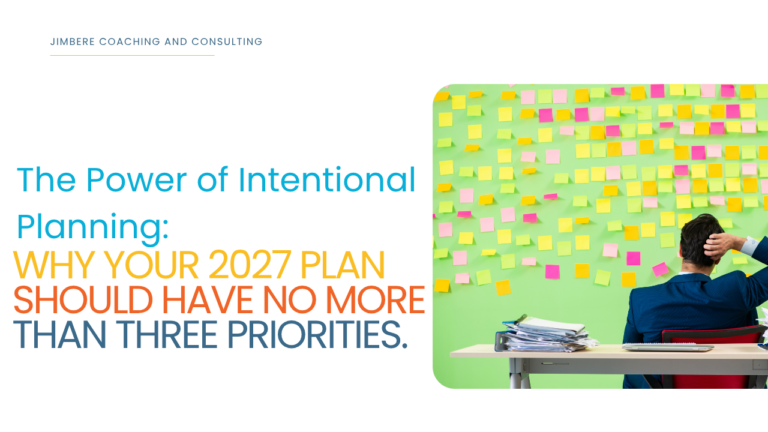
If everything is important, your team will eventually treat nothing as important.
As leaders, we often mistake activity for progress.
The calendar is full. The team is busy. There are strategic initiatives underway, operational demands to manage, customers to serve, people to develop, opportunities to pursue and problems that need attention.
And then we wonder why everyone feels overwhelmed.
The answer isn’t always that your team needs to work harder, become more efficient or learn another productivity system.
Sometimes, they simply have too many priorities.
That is why I believe intentional planning is one of the most important leadership activities you can undertake before a new year begins.
And if you want 2027 to be different, November is a much better time to create that difference than January.
Don’t Start With: “What Do We Need to Accomplish?”
When I work with leaders on planning, I encourage them to resist the temptation to immediately create a list of goals.
Instead, start with reflection.
Before deciding where you are going, ask:
- What worked this year?
- What didn’t?
- What did we learn?
- What has changed in our market, organization or customers?
- Where are we spending significant energy without seeing meaningful results?
- What should we stop doing?
- What opportunities are worth pursuing?
- What absolutely must change for us to be successful next year?
This is where intentional planning begins.
You are not simply creating a list of things you hope to accomplish.
You are deciding what deserves your organization’s limited time, energy, attention and resources.
That distinction matters.
The 3-WIG Rule: Fewer Goals. Greater Execution.
One of the principles I use in business planning comes from the 4 Disciplines of Execution (4DX) framework: identify the Wildly Important Goals, or WIGs.
The key word is important.
Not everything can be wildly important.
If you have eight “top priorities,” you don’t have eight priorities.
You have eight competing demands for attention.
For most leaders and teams, I recommend identifying no more than three WIGs for the year.
Sometimes the right answer is two.
Sometimes it is one.
The discipline is not in finding more things to accomplish.
The discipline is in deciding what matters most.
Your WIGs should answer a simple question:
If we accomplished only these few things in 2027, would we consider the year a success?
If the answer is no, keep refining.
Then Map the Priorities Beneath the WIGs
A WIG is not the entire plan.
It is the anchor.
Once you have identified your one to three wildly important goals, map the major priorities, initiatives and actions that will support them.
This is where many strategic plans become overwhelming.
A leader creates a WIG and then attaches 17 projects to it.
Now you’ve simply created a prettier version of the problem.
Instead, ask:
What are the few things we must do exceptionally well to move this goal forward?
Then ask:
What can wait?
And perhaps the hardest question:
What are we willing to stop doing?
Strategic planning requires subtraction.
Your team’s capacity is finite. Every new priority consumes attention that cannot simultaneously be given to something else.
Move From Lag Measures to Lead Measures
Another valuable concept from 4DX is the distinction between lag measures and lead measures.
A lag measure tells you whether you achieved the result.
For example:
- Revenue increased by 10%.
- Client retention reached 95%.
- Employee engagement improved by 8%.
- Profit margin increased.
Those outcomes matter.
But you cannot directly control most lag measures.
Lead measures are the actions or behaviours that influence them.
For example:
If your WIG is to increase revenue, your lead measures might involve:
- Number of strategic client conversations
- New business proposals submitted
- Advisor appointments completed
- Conversion activities
- Specific sales behaviours
The power comes from connecting the outcome you want with the behaviours your team can actually influence.
Don’t just tell your team what result you want. Define what they need to do differently to create it.
Give the Plan a Scorecard
A plan sitting in a PowerPoint deck is not a strategy.
It is a document.
Your team needs a visible way to know whether you are winning.
A simple scorecard can answer:
Where are we?
Where should we be?
What commitments have we made?
Are we doing the things that should move the needle?
This creates a shift from:
“We’re really busy.”
to:
“We’re making progress against what matters most.”
Those are very different conversations.
The Real Purpose of Planning Is Not the Plan
This may be the most important point.
The purpose of planning isn’t to predict the future perfectly.
You can’t.
Markets change. Customers change. Employees change. Priorities change. Unexpected opportunities and challenges appear.
The purpose of intentional planning is to establish a decision-making framework.
When something new lands on your desk in March, you should be able to ask:
Does this advance one of our WIGs?
If it does, determine where it fits.
If it doesn’t, you have a decision to make.
Is it genuinely more important than something already on the list?
If yes, something else needs to come off.
That is strategic leadership.
Plan in November. Start January With Clarity.
Waiting until January to develop your annual plan sounds logical.
It isn’t always strategic.
By January, the year has already started.
Calendars fill quickly. Budgets are being executed. Teams are responding to immediate demands. Leaders are pulled into operational issues.
Instead, imagine entering January already knowing:
- What matters most
- What you are intentionally not pursuing
- What your team’s priorities are
- What success looks like
- What behaviours will drive that success
- How progress will be measured
- What the first 90 days need to accomplish
That’s a very different way to start a year.
You’re not starting January planning. You’re starting January executing.
Your 2027 Planning Questions
Before you finalize your plan, challenge yourself and your leadership team with these questions:
1. What did we learn in 2026?
Don’t rush past the lessons.
2. What needs to change in 2027?
Be specific.
3. What are our one to three WIGs?
If you have more than three, challenge whether they are truly priorities.
4. What must we do consistently to achieve them?
Identify the lead measures.
5. What are we going to stop doing?
Make room for the priorities.
6. How will our team know whether we’re winning?
Create a simple scorecard.
7. What needs to happen in Q1?
Turn the annual strategy into a 90-day launch plan.
8. What will we do when competing priorities emerge?
Agree on the decision-making rules before the pressure arrives.
Intentional Planning Is a Leadership Practice
The best plans don’t eliminate uncertainty.
They eliminate unnecessary ambiguity.
They give leaders the confidence to say:
“This matters.”
“This doesn’t.”
“This is what we’re doing now.”
“This can wait.”
And perhaps most importantly:
“We do not need to do everything.”
Your team doesn’t need another year of being busy.
They need clarity about what matters most.
If you want 2027 to be a year of meaningful progress rather than another year of competing priorities, give yourself and your leadership team the space to think before the year begins.
Complete the plan in November.
Clarify the priorities.
Choose your WIGs.
Map the lead measures.
Build the scorecard.
Decide what you will stop doing.
Then give your team something far more valuable than a long list of goals:
Focus.
Need a thinking partner for your 2027 planning?
Sometimes the hardest part of strategic planning isn’t knowing how to plan.
It’s having someone outside the day-to-day whirlwind who can challenge your assumptions, ask the questions your team may be avoiding, help you distinguish what’s genuinely important from what’s simply urgent, and turn a collection of ideas into a focused plan your team can execute.
That’s the work I love.
I help business owners and leaders step out of the whirlwind, look objectively at where they are going, identify what matters most, and build a practical plan for moving forward.
Because high performance shouldn’t require operating in overwhelm.
If your 2027 plan is still living in your head—or if your current planning process produces a long list of priorities instead of genuine focus—November is the time to do something about it.
We can book in a VIP planning day together before the end of November. Set a Saturday aside to work on your business instead of in your business.
Let’s make 2027 intentional. Book a call today to talk about how we can partner together.