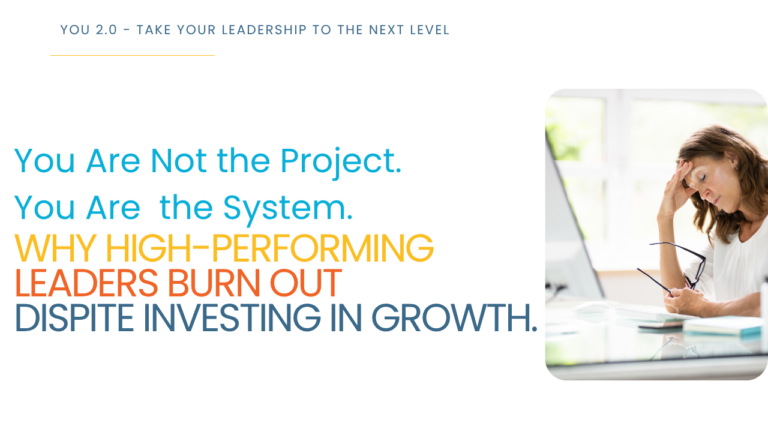
You are the most important system you will ever optimize.
Every year, many high-performing leaders commit to professional development.
You invest in:
- Courses
- Books
- Certifications
- Mentorship
- Coaching
On paper, it’s exactly what you should be doing.
And yet—if you’re honest—something doesn’t fully translate.
You’re still performing. Still delivering. Still leading at a high level.
But it feels harder than it should.
The Hidden Problem with Professional Development
Most leaders treat growth like accumulation.
More knowledge. More frameworks. More tools.
The assumption is simple: 👉 If I learn more, I’ll perform better.
But here’s where that breaks down:
You don’t execute leadership from what you know. You execute leadership from how you operate.
And those are not the same thing.
You can:
- Read the right books
- Attend the right programs
- Learn the right strategies
…and still feel:
- Overextended
- Mentally fatigued
- Stuck in patterns that don’t scale
Because the issue isn’t information.
It’s integration.
You Are Not the Project. You Are the System.
Here’s the shift that changes everything:
👉 You are not the project you’re working on. You are the system producing the results.
And if the system isn’t optimized, no amount of effort will fix it.
This is where high-performing leaders get caught.
You’ve been rewarded for:
- Working harder
- Figuring it out
- Carrying more
So when something feels off, your instinct is: 👉 “I’ll double down.”
But at a certain level of leadership, effort stops being the advantage.
And becomes the constraint.
Why High Performers Burn Out (Even While Growing)
Burnout at this level isn’t about lack of capability.
It’s about misaligned operating systems.
It shows up as:
- Constant decision fatigue
- Carrying too much responsibility personally
- Difficulty disconnecting from work
- Feeling like you’re always “on”
- Success that looks good externally—but feels heavy internally
And here’s the critical insight:
👉 You can be growing… and still be operating inefficiently.
That’s the gap most professional development doesn’t address.
The Difference Between Learning and Optimization
Let’s separate two things that often get confused:
Learning:
- Adds knowledge
- Expands awareness
- Introduces new ideas
Optimization:
- Changes behavior
- Simplifies decision-making
- Reduces unnecessary effort
- Increases output without increasing strain
Most leaders stay in learning.
Few move into optimization.
Because optimization requires:
- Letting go of old patterns
- Rethinking identity
- Changing how you lead—not just what you know
What Optimized Leadership Actually Looks Like
When leaders shift from accumulation to optimization, the results are measurable.
They don’t:
- Work less
- Care less
- Lower their standards
They operate differently.
You start to see:
- Clearer priorities and faster decisions
- Reduced cognitive overload
- Stronger, more capable teams
- Less rework and fewer bottlenecks
- Energy that’s sustained—not constantly depleted
And perhaps most importantly:
👉 High performance starts to feel controlled—not chaotic.
Growth Without Burnout: What Changes
Inside my work with high-performing leaders, this is the transformation we focus on.
Not adding more.
But removing what’s no longer serving how you lead.
Leaders I work with often come in thinking they need:
- Better time management
- More structure
- More discipline
What we uncover instead is:
- Misaligned priorities
- Over-functioning in areas they shouldn’t be
- Leadership patterns that don’t scale
From there, we optimize:
- How decisions are made
- Where energy is spent
- How teams are led and developed
- What actually drives results vs. what creates noise
The result?
– Increased performance
– Reduced burnout
– Sustainable leadership at a higher level
This Is the Work Inside YOU 2.0
This is exactly what we do inside the YOU 2.0 leadership partnership.
This isn’t another layer of:
- information
- strategy
- or surface-level coaching
It’s a structured approach to: 👉 evolving how you operate as a leader
Over 3, 6, or 12 months, we focus on:
- Identifying what’s making leadership harder than it needs to be
- Eliminating inefficiencies in how you think, decide, and lead
- Building systems that support sustainable high performance
- Strengthening clarity, confidence, and leadership presence
This is where growth becomes:
- intentional
- integrated
- and sustainable
The Shift Most Leaders Avoid (But Need)
If you’re a high performer, this may be the hardest truth to accept:
* The way you’ve been leading is not wrong.
* It’s just no longer the most effective way forward.
And holding onto it—because it’s worked before—is what keeps leadership feeling heavier than it should.
Optimization requires:
- Letting go of what got you here
- Trusting a new way of operating
- Being willing to lead differently
Not because you have to.
But because it’s the only way to sustain success at the next level.
Final Thought
You don’t need more development.
You need better alignment between how you lead and what your role requires now.
Because:
👉 You are not the project.
👉 You are the system.
And when the system is optimized:
- performance increases
- pressure decreases
- and leadership starts to feel the way it was meant to
Clear. Controlled. Sustainable.
If you’re ready to stop adding more—and start operating differently—
This is the work.
And it’s exactly what we build together inside YOU 2.0.
High performance shouldn’t feel this hard. Create clarity, confidence, and sustainable performance so success feels as good as it looks.